
Harry Beck’s 1933 redesign of the London Underground map was geographically wrong. It was also the most useful transit diagram ever drawn.
Beck threw away the actual distances between stations, flattened the Thames, and constrained every line to horizontal, vertical, or forty-five degrees. The result was deeply wrong about where anything actually sits in relation to anything else.
Beck had realised he was solving the wrong problem. The old map answered “where are the stations relative to each other on the surface of London.” Nobody needed that. The new map answered “how do I get from here to there and where do I change.” Everyone needed that. The map had the right model for the question being asked, which turned out to be much more useful than having the right map for a question nobody was asking.
Technology estates are not the London Underground. They are considerably messier, do not run on a timetable, and nobody has yet made a Harry Beck version of one. This is part of the problem. This is an attempt to do something about that.
Why Architecture Diagrams Are Mostly Useless
The standard artefacts of enterprise architecture (the system landscapes, the integration diagrams, the “current state” boxes and arrows) tend to fail in a specific way. They try to be accurate. They include every system. They show every integration. They use box sizes and arrow weights to convey meaning, and then nobody can agree on what any of the sizes and weights mean, and the diagram becomes a conversation about the diagram rather than about the technology estate it describes.
The result is something that is technically thorough and practically useless. It describes the archaeology of a technology estate: how decisions accumulated over time, what got connected to what, where the bodies are buried. It does not answer “what is this estate actually capable of” or “where does investment need to go” or “what happens when this system is decommissioned.” These are the questions that matter. The diagram does not answer them.
The other failure mode is the opposite: the strategy slide that shows three circles labelled Platform, Operations, and Customer, which answers nothing specific and whose main function is to allow a workshop to end feeling like progress was made. Both types of artefact exist in most organisations. Neither is the Underground map.
The question is what that map would look like for a technology estate.
A Minimum Viable Model
The question I kept coming back to was not “how do we model technology estates” but “what is the minimum number of types of thing you need to represent for the model to be genuinely useful.” This is a different question. It stops you from adding things because they are real and forces you to only add things because they help someone make a decision.
There was a second constraint. Enterprise architecture has historically been done by architects for architects. The artefacts it produces are often incomprehensible to the people who have to act on them: the finance director approving investment, the operations lead owning the capability, the engineer being told what to build. A model that only a trained architect can read or build has limited reach. The goal was something that could be explained in ten minutes to any of those people and that they could then participate in building. Architecture should not require an interpreter.
ArchiMate exists. It is a rigorous enterprise architecture modelling language with formal semantics, defined layers, and a comprehensive vocabulary. For organisations that have trained practitioners and need that level of precision, it is a good answer. The problem is the second condition. ArchiMate diagrams require specialist knowledge to read. The finance director approving the investment cannot parse one. The operations lead being asked to validate the capability model cannot either. A notation that requires an architect at each end of every conversation has the same reach problem as the boxes-and-arrows diagram, just more formally dressed. Topo takes the opposite bet: fewer concepts, accessible to anyone, good enough to make the decisions that matter.
The answer, after more whiteboard sessions than I am going to list here, was five primitives.
Five types of thing. If you can describe your technology estate in terms of these five things and the relationships between them, you have enough to reason about capability, investment, maturity, risk, and change. If you cannot, the model needs to be extended. After a little while of using it, that has happened once, and the extension was eventually rolled back.
The Five Primitives
Domain is a business area. Not a team. Not an application. Not a cost centre. A business area: a coherent set of activities that the organisation does. Payments. Customer Support. Logistics. The boundary is not drawn by the org chart, and it is not drawn by the IT estate. It is drawn by asking “what does this part of the business actually do.” Getting this right is harder than it sounds and tends to be where the most useful conversations happen, usually because two people who thought they agreed about scope discover, in the act of drawing the boundary, that they did not.
Capability is what a Domain can do. A Domain has Capabilities. Customer Support has the Capability to handle inbound queries. It may also have the Capability to do proactive outreach. Each Capability has a maturity level from one to five. This is not a judgement and not a target. It is a description of current state on a defined scale. This turns “our query handling is a bit rubbish” into a number, which makes it possible to compare, track, and prioritise without spending the first forty minutes of every meeting arguing about what “a bit rubbish” means to different people in the room.
App is what delivers a Capability. An App is a piece of software. It has a deployment type: SaaS, PaaS, Custom, or AI Agent. AI Agent is a relatively recent addition to that list and reflects the fact that an agent that calls tools and returns a result is now a meaningful deployment type with its own cost profile, change characteristics, and risk shape. One Capability can be delivered by one App or by several. One App can contribute to multiple Capabilities. The deployment type matters because it determines what kind of investment changes it and how quickly it can evolve.
Flow is how Apps communicate. It has a type: REST, Events, batch, file transfer. A Flow without a type is an arrow that says “these two things are connected somehow,” which is nearly no information at all. A Flow with a type says something about reliability, latency, coupling, and what breaks when either end changes. The difference between REST and Events is an architectural decision with real consequences. The model should record it.
People is who interacts with the system. Not an org chart. The actor at the boundary between human and technology. A People node can represent a named individual, a general role, a team, or an external company: the granularity depends on what the model is for. What matters is not who works at the organisation but who actually uses the Capability, because that is where the Capability succeeds or fails. An estate with no People nodes is describing itself to itself.
Five things. Everything else is derived from them.
A simple worked example makes this concrete. A WordPress site with Algolia powering the search: one Domain (Content and Discovery), two Capabilities, three Apps (WordPress as Custom, the theme as PaaS, Algolia as SaaS), a REST Flow for search queries, one People node. What the deployment types tell you immediately is that swapping the search provider is a configuration decision, not a rebuild.
One Model, Multiple Questions
The useful property of a model built this way is that the same underlying data answers different questions without being re-entered or re-drawn. Ask about Capability maturity and you get a view of where the estate is strong and where it needs investment. Ask about App deployment types and you get a picture of commercial exposure and cost of change. Ask about Flows and you get a map of coupling: which Apps are tightly bound to each other, which changes will cascade, where the fragile points are.
These are not separate diagrams. They are different lenses on the same model. This matters because once you have separate diagrams for different questions, you have the problem of keeping them in sync, which you will not reliably do, and within six months you have three diagrams that partially contradict each other and a team that has quietly stopped believing any of them. This is not a hypothetical failure mode.
One model, updated in one place. Different questions get answered by reading the model differently, not by maintaining it differently. The discipline required is in keeping the model accurate, which is a single discipline rather than the distributed, uncoordinated discipline of maintaining many documents simultaneously.
Each element in the model exists once. The Commerce Engine lives as a single record in the model. It appears on every view that includes it, carries its deployment type and any other attributes, and updating it in one place updates every lens simultaneously. There is no synchronisation problem because there is nothing to synchronise.
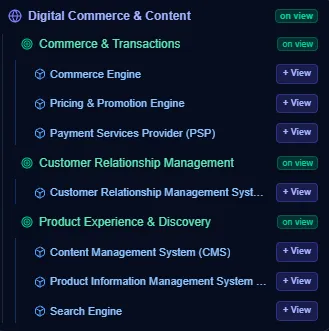
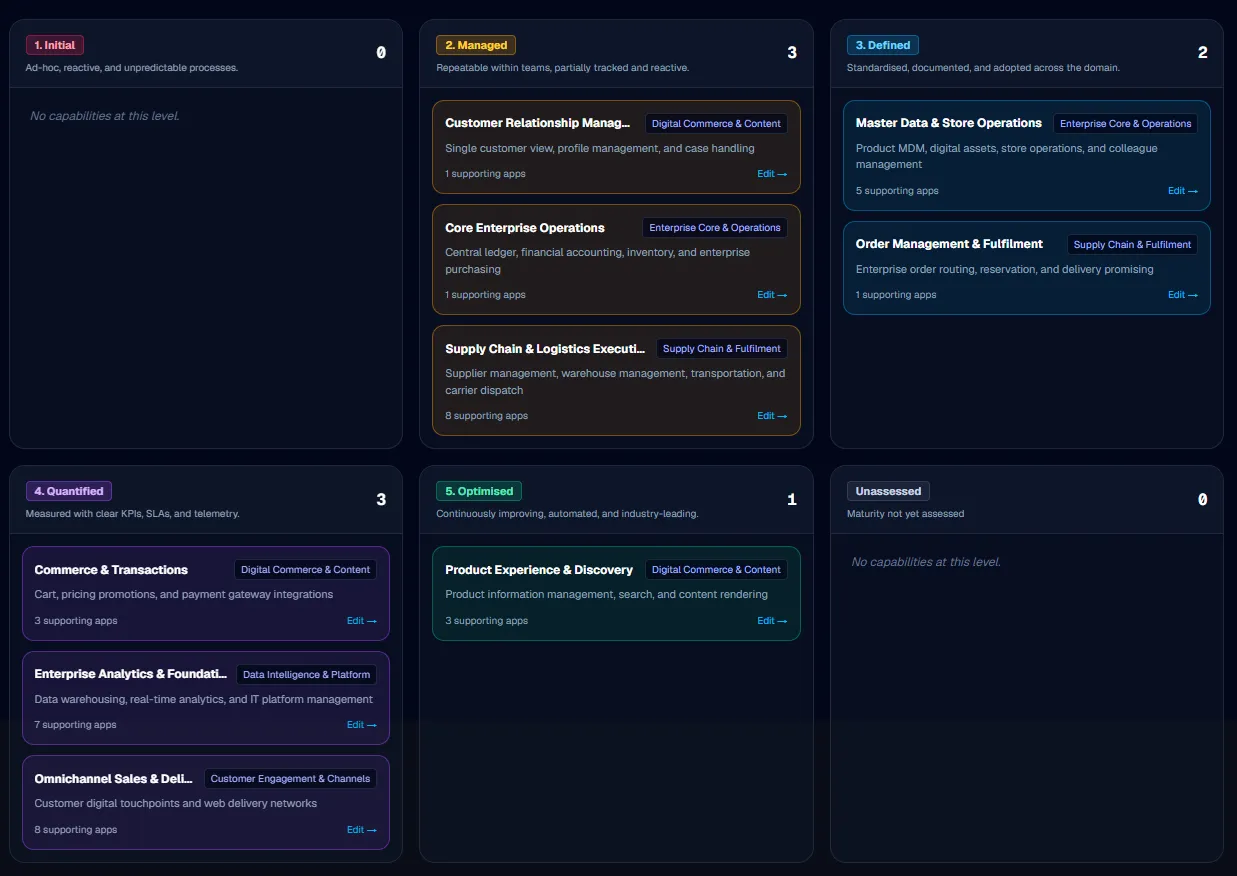
The same retail technology estate looks like this as a capability map: five domains, eight capabilities, each with a current maturity rating.
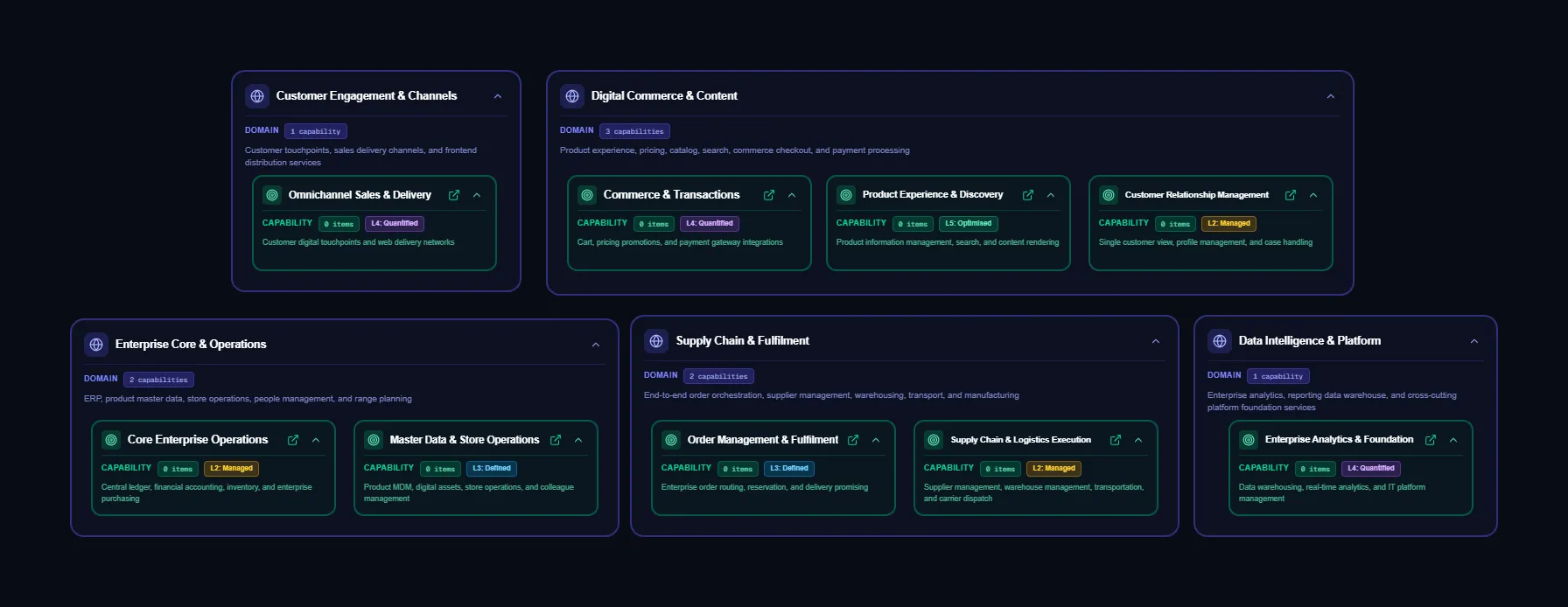
Filter by maturity level and the picture changes entirely. The same eight capabilities, now sorted by where they sit on the scale, make the investment question immediate without a single new piece of data being entered.
What It Does Not Solve
A model is not the estate. This one is not an exception.
Topo sits between process modelling and system architecture and is not trying to replace either. Process was a serious candidate for a sixth primitive. It was cut because how work moves through an estate is a real and important question that already has better tools: BPMN and its equivalents do that job. At the other end, C4 and similar notations handle the question of how a specific system is built inside. Topo operates between those two levels. It records that an Order Engine exists, what Capability it delivers, and what Flows connect it. How the Order Engine is built inside is a different question for a different model.
The primitives are precise, but the information put into them reflects what people know, what they are willing to say out loud, and how carefully the definitions were applied. A Domain boundary drawn badly produces a model that accurately describes a badly drawn Domain. A Capability maturity level agreed by committee in a workshop reflects the room, not the reality. The model is only as good as the conversation that produced it, and organisations are complicated.
The model also does not say what to do. It describes what is there. Investment decisions, sequencing, and prioritisation come from people applying judgement to what the model surfaces. The model makes the conversation more precise. It does not replace the conversation, and it would be a mistake to use it as though it did.
What it does do is give that conversation a shared object to argue about. This is more useful than it sounds. A lot of architecture discussions fail not because the participants disagree about priorities but because they are describing different models of the same estate and do not realise it. One model in the room, understood to be the reference, changes the character of the conversation substantially. Not always to agreement, but at least to productive disagreement about the actual thing.
AND FINALLY
The name. Topo is a compression of topography and topology, applied to enterprise architecture. Topography: the shape of the terrain, what is high and what is low, where things sit relative to each other. Topology: the connections, the structure, the properties that hold regardless of how you scale or stretch the map. Both concepts are doing work in the model. Neither requires geographic accuracy, which is rather the point.
Beck’s Underground map works because it committed to answering one question well rather than many questions badly. It is topology: the connections and the sequence, not the geography. It does not tell you how far it is from Bank to Monument. It tells you they are on the same line, which is the only thing that matters when you are trying to get somewhere.
The Topo modelling approach is an attempt at the same trade as Beck’s map. Five primitives, one model, multiple lenses. Not a complete description of a technology estate (no map is a complete description of the territory) but the right level of abstraction to reason about what the estate is capable of, where it is weak, and what needs to change.
The hardest part was not building it. It was accepting that five things was enough.
If you work in enterprise architecture, or have to make decisions based on it, I would like to know: what does the architecture conversation in your organisation actually argue about?